Best DnD Journal for Players: Record Every Adventure
A good DnD journal turns your campaign into something you can actually look back on. Here's what to look for in a player journal — and the best options for documenting your adventures.
At some point in a long campaign, you will forget something important. The name of the merchant who gave you the quest in session three. What the party decided to do about the locked door in the dungeon. Why your character has a grudge against the thieves' guild. It happens to everyone.
A dedicated DnD journal fixes this — not because it makes you more organized as a person, but because it gives you a single place to put things down so you can actually find them again. The difference between a purpose-built DnD journal and a blank notebook is structure. When the sections already exist, you use them. When it's a blank page, you improvise and lose things.
These are the best options for players specifically — not DM tools, not digital apps, just physical journals built around the player experience.
What Makes a Good DnD Journal for Players
Players need different things from a journal than DMs do. You're not tracking encounter balance or NPC factions from above — you're documenting your character's perspective. That means the best player journals are built around a few core things:
- Character tracking — stats, backstory, development over time
- Session notes — what happened, who you met, what decisions were made
- Quest and goal log — active quests, completed quests, loose threads
- NPC notes — names, relationships, what they know or want
- Inventory and loot — especially for longer campaigns where items matter
A blank notebook technically covers all of this, but you'll spend the first ten minutes of every session staring at empty pages trying to remember what you were supposed to write down. Pre-structured sections remove that friction.
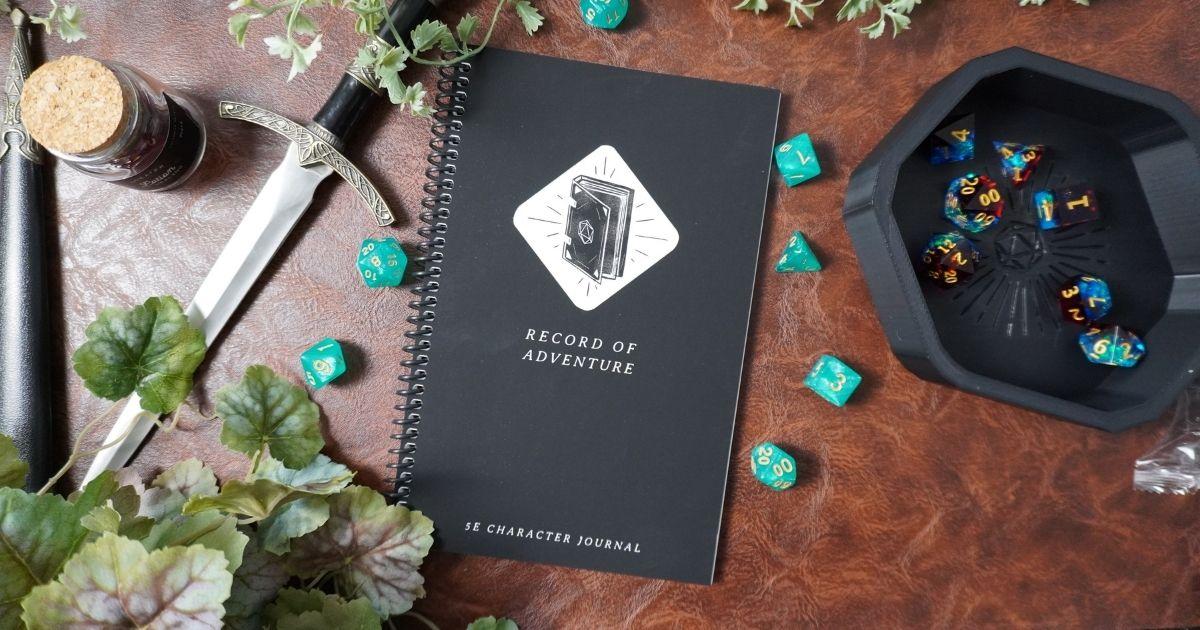
Record of Adventure — Best for Players Running One Character
If you're committed to a single character through a campaign, the Record of Adventure is the one. It's built specifically for the player experience — sections are organised around your character's journey rather than the DM's overhead.
The layout gives you dedicated space for character development, session-by-session recaps, quest tracking, and NPC notes. It's 5e compatible, so the mechanical sections map directly to how D&D 5e actually works. But the narrative sections — the parts where you write down what happened and why it mattered — are what make it genuinely useful for a campaign that runs more than a few sessions.

The physical format also matters. There's something about writing session notes by hand that makes them stick better than typing into a notes app between rolls. It slows you down just enough to process what happened, which is most of the value.
See Record of Adventure in Action
Character Compendium — Best for Players With Multiple Characters
Not everyone plays one character start to finish. Some players run multiple campaigns at once. Some groups rotate characters between arcs. Some people just die a lot.
For that kind of player, the Character Compendium makes more sense. It's a multi-character journal — built to hold several characters in one book, each with their own sections. Instead of buying a new journal every time you start a new character, you have one place that travels with you across campaigns.

It's also 5e compatible and structured around the same core player needs — character info, session notes, quests, NPCs — just with the capacity to handle more than one character at a time.
Which One Should You Get?
Straightforward answer:
| If you… | Get this |
|---|---|
| Play one character per campaign, long-form | Record of Adventure |
| Rotate characters or play multiple campaigns | Character Compendium |
| Want one for you and one for a gift | Both — they complement each other |
Both are physical, both are 5e compatible, and both are built for players rather than DMs. The distinction is really about how many characters you're juggling at once.
The best DnD journal is the one that matches how you actually play — not the most feature-packed one.
What to Write in Your DnD Journal Each Session
Keeping a journal only works if you actually use it. A few things worth writing down every session — even if you only have five minutes:
- One or two sentences on what happened and what your character decided
- Any new NPCs you met — name, who they are, how they felt about you
- Any quests picked up, completed, or changed
- Notable loot or items that might matter later
- One thing your character learned or how they changed
You don't need to transcribe the whole session. A few anchoring details is enough to bring everything back when you sit down for the next one. The journal sections in both Record of Adventure and Character Compendium are built around exactly this — quick enough to fill in at the table, useful enough to refer back to later.
If you're looking at the DM side of things — tracking worlds, NPCs, and campaign prep — the DnD session notes template guide and the worldbuilding template post cover that side.
Frequently Asked Questions
What is a DnD journal?
A DnD journal is a physical notebook structured specifically for tabletop RPG players. Unlike a blank notebook, it includes pre-built sections for character info, session notes, quests, NPCs, and loot — things you need to track in most campaigns.
What should I put in a DnD campaign journal?
Character stats and backstory, session-by-session notes, NPC names and relationships, quest logs, and notable loot. You don't need exhaustive notes — just enough to orient yourself at the start of the next session.
What is the best DnD journal for players?
For a single character through a campaign: Record of Adventure. For players rotating between multiple characters or campaigns: the Character Compendium. Both are 5e compatible and built specifically for the player side of the table.
Is a DnD notebook different from a regular journal?
Yes. A DnD notebook has structured sections built around how TTRPGs actually work — ability scores, spell slots, quest logs. A regular notebook is blank. The structure is most of the value.
Can I use a DnD journal for systems other than 5e?
Yes. The mechanical sections are 5e compatible, but the narrative sections — session notes, NPC tracking, quest logs — apply to any tabletop RPG system.
Related reading
Ready to start documenting your campaign?
Both journals are 5e compatible and built for the player experience. Pick the one that fits how you play.